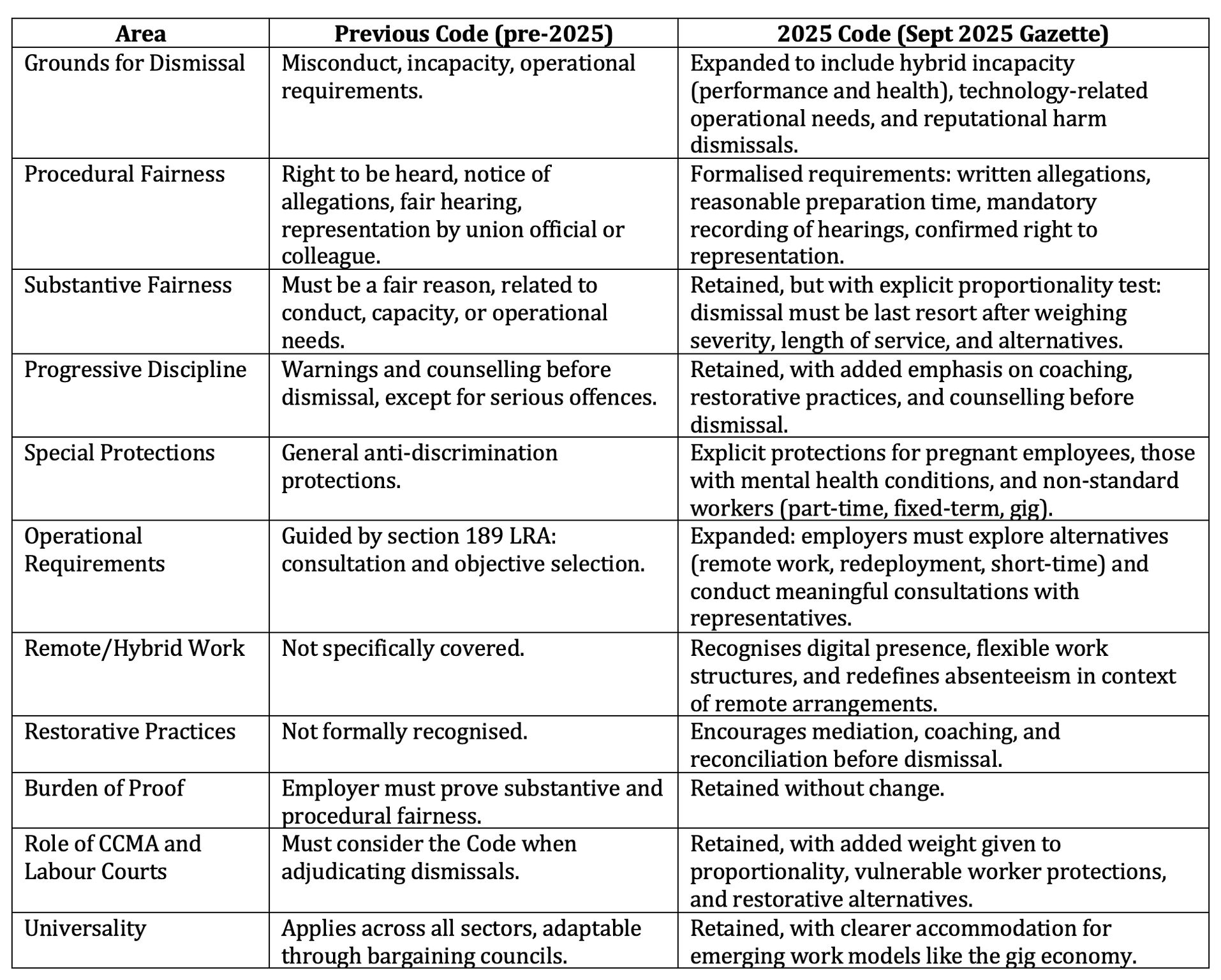

The Minister of Employment and Labour has officially issued a new Code of Good Practice: Dismissal, which was gazetted on 4 September 2025 (Government Gazette No. 53294). This Code replaces the earlier framework under Schedule 8 of the Labour Relations Act, 1995 and provides updated guidance on how dismissals must be handled in South Africa.
Why the New Code Matters
Dismissal remains one of the most sensitive and contested areas in employment law. The new Code reaffirms that employers must balance their managerial prerogative with fairness, accountability, and respect for workers’ rights. For employees, it reinforces their right to challenge unfair terminations and to expect transparency in the process.
The Code is not a rigid checklist, but a set of principles designed to guide employers, employees, unions, and dispute resolution bodies in ensuring dismissals are lawful and procedurally fair.
Key Features of the 2025 Code
1. Fairness Above All
A dismissal is only fair if it is based on a valid reason and follows a fair process. The Code identifies three broad grounds for dismissal:
- Misconduct (breach of workplace rules or standards),
- Incapacity (poor performance or ill-health), and
- Operational requirements (retrenchments driven by economic, technological, or structural needs).
2. Misconduct and Discipline
Employers are encouraged to use progressive discipline before resorting to dismissal. Sanctions such as counselling, warnings, and suspensions should be applied where appropriate. Only serious or repeated misconduct may justify termination.
Importantly, disciplinary rules and procedures must be clear, accessible, and consistently applied across the workplace1756999848230.
3. Procedural Safeguards
The Code requires that employees be given a genuine opportunity to respond to allegations before any decision is taken. Investigations need not be overly formal, but fairness requires:
- Written notice of allegations,
- A reasonable opportunity to prepare and respond,
- Representation where appropriate, and
- Consideration of mitigating factors.
4. Probation Periods
Employers may place new employees on probation, but dismissal during this period must still follow fair procedures. Employees must be given guidance, counselling, and an opportunity to improve performance before termination is considered.
5. Incapacity and Ill-Health
Dismissals for poor performance or ill-health must be handled with sensitivity. Employers are expected to provide training, reasonable accommodation, and, where relevant, opportunities for rehabilitation. Special consideration must be given to employees injured at work or those with long-term health conditions.
6. Operational Requirements (Retrenchments)
Where dismissals are based on retrenchments, employers must consult meaningfully with employees or unions. The process must explore alternatives, selection criteria must be fair and objective, and affected employees should receive severance pay and possible re-employment preferences.
Practical Implications for Employers
- Policy alignment: Employers should review and update disciplinary and HR policies to ensure consistency with the new Code.
- Training: Managers, HR practitioners, and shop stewards need training on applying the Code correctly.
- Record-keeping: Proper documentation of warnings, consultations, and disciplinary steps will be vital in disputes.
What Employees Should Note
- You have the right to know the reason for your dismissal and to be heard before a decision is made.
- If dismissed, you may challenge the fairness of the decision at the CCMA or relevant bargaining council.
- Retrenched employees have rights to severance pay, consultation, and preferential re-employment.
Conclusion
The 2025 Code of Good Practice: Dismissal signals a continued emphasis on fairness, transparency, and due process in South African labour law. Both employers and employees should familiarise themselves with its provisions. For businesses, compliance is not just a legal obligation, it is a safeguard against costly disputes. For employees, the Code is a reaffirmation of their right to dignity and fairness in the workplace.